3 Reasons Why Social Media is Killing Search

The two main drivers of search are, news and finding something you already know exists.
I recently wrote about how in an apples to oranges comparison bitly was challenging Google. One commenter thought I was a loon or a complete idiot for trying to compare the two. In all fairness I may not have explained why the two are worthy of being compared. bitly and Google both have the same purpose: deliver you to a useful website. That’s it. The difference is that one is performed by search queries the other is initiated by a recommendation.

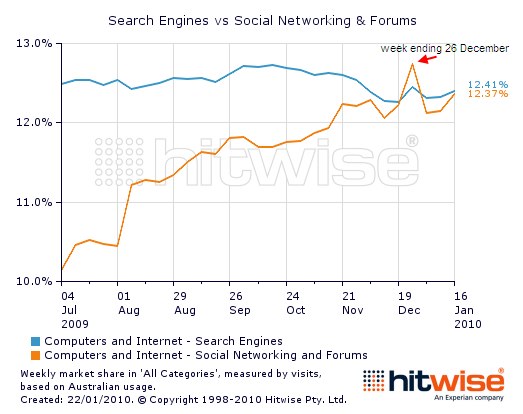
Read/Write Web reports on some coverage from HitWise

Social networking climbed fast this year, and Hitwise says it just peaked over search for a few days during the communication frenzy of Christmas. Take that, Larry and Sergey – Mark and Ev are right behind you.

Social Recommendations

When news breaks we are turning to search engines less and less. We are turning to each other and the real time results of social networks more and more. For breaking news I know that I’ll find a relevant link on Twitter and an outdated news story on Google. I only see one reason this trend will stop (which I’ll get to in my last point).

Better Curating

With so much data out there, curating is going to be a huge trend this year and good curators will be in high demand. The tools we have now for bookmarking (delicious & diigo), favoriting (Google reader and Twitter), listing (Twitter and Listorous), and storing offline (Instapaper and Evernote) are constantly getting better making the need to go to a search engine irrelevant.

Lack of Search Innovation

This is the biggest problem and the thing that Google, Bing and every startup in search is trying to fix. The reason that Bing and Google are tripping over each other to integrate real time data is they are trying to get us all to come to them first when we here of breaking news. And I think that over time it will pay off. With all the noise and rising levels of spam in social media search has an advantage. If they can bring you immediate, real time results, they have a chance since they already have a pretty good handle on filtering spam.

Of course they’ll also get there by making some key acquisitions this year. Who are your bets on the first real time search starups to be acquired?

Reblog this post [with Zemanta]

Popularity: 15% [?]

Share and Enjoy:
  • del.icio.us
  • Facebook
  • Google Bookmarks
  • StumbleUpon
  • Tumblr
  • Diigo
  • Posterous
If you enjoyed this post, make sure you subscribe to my RSS feed!
Tagged with:
 
  • Awesome. Thanks for breaking it down for someone who is not the most tech savvy. Very clear and very interesting!
  • I like your elevation of "curation", and agree that social recommendation is an increasingly important component of discovering interesting and useful things online (very much in line with Jeremy Meyers' distinction between search and discovery).

    However, I hope that in the quest for innovation, search does not become overly influenced by social media usage. danah boyd posted an insightful piece a while back about valuing inefficiency and unreliability, in which she emphasized the value conferred by effort. It seems to me that many Twitter users tweet (or retweet) a link to a long article or story without reading it (completely), or tweet a link to a short summary of a longer essay ... possibly drawn in by a catchy headline and/or an engaging first paragraph (and no, I won't say anything more about headlines, given another thread in these comments :).

    My concern is that Twitter and other social media services are promoting a "snack culture", and without search algorithms that are not [as heavily] influenced by the memes of the moment, our ability to find original sources - or insights and experiences that may not be currently trendy - may suffer.

    As a potential analogy, I'm reminded of a study, Voting With Your Feet: An Investigative Study of the Relationship Between Place Visit Behavior and Preference, where Jon Froehlich and his colleagues found that the restaurants people visit most often do not correlate well with the restaurants they actually like or value the most ... they are simply most convenient. There's a place for convenience - online and offline - but I hope search innovations will not sacrifice breadth and depth for radical immediacy.
  • Great comment Joe. Although I struggle to call it a comment since it's really a post unto itself. All excellent points.
  • Thanks, Tac. Your observation about my comment being "a post unto itself" led me to take the comment back home, so to speak, and integrate it into a blog post I'd been writing on the commoditization of Twitter followers, where it provided a missing piece to tie together a few loose ends at the conclusion.
  • I think this brings up a really interesting point: Google/Bing/etc have historically been the home for both Search and Discovery. Now the two are being teased apart into separate channels.


    My action when I want to FIND something is to go to a search engine. My action when I want to DISCOVER something is to read the social feeds of people who are into the kind of thing I'd be interested in discovering.
  • jfeuer
    Agree with this post and would add that smartphone adoption and the new app platforms will make search less relevant than we are used to on PCs. Google is trying hard to limit this affect with there Nexus One phone and Android system. Digital marketers need to understand these user behavior, technology and u x changes and plan a more holistic, integrated digital marketing plan that including SEM, SEO, Display, Social, Mobile, etc.

    See my post on this topic at Digital Street Smarts. http://bit.ly/6B5xwh
  • Great point I didn't even get into mobile behavior. I know I'm especially more likely to seek recommendations and consume Twitter links when I'm mobile than I do when I'm at my desk or at home. And most of the time when I'm home I'll usually use my phone before turning on the computer. Great post by the way. Very solid recommendations.
  • jfeuer
    thanks, Tac. could you Tweet this blog post - http://bit.ly/6B5xwh - I could use the exposure...appreciate it.
  • SocialSteve
    Definitely a touchy subject that brings out much emotion. I do agree with your premise here and covered this topic in an article - "Social Media – Should Make Companies Rethink SEO" at http://bit.ly/7eW8n - caught many passioante replies.

    The main point is that companies need an INTEGRATED approach and split resources and budgets for both SEO and social media. (Not just SEO.) There are numerous ways to capture awareness and drive traffic. While SEO is still important, some of the resources that marketing allocated to SEO need to be transfered to social media.

    And as a last point - SEO is push, social media is pull - think about it.

    Social Steve
  • I agree on all accounts. I never said SEO or search was dead. It;s still important and needs to be incorporated into what we do, especially as search evolves and becomes more social.

    The only point I may disagree with you on is the push versus pull part (which I see some of your commenters to your post did as well.

    Advertising is push, social can often be a push (but I do see how it can be pull) but I have a hard time seeing how SEO is push since the user had to initiate it.
  • gearheadgal
    I'm really disappointed by the cheap blog headline strategy (especially for a Wagged Social Media expert) and the limited view of search technology represented here. It makes serious technologists distrust bloggers when they make uninformed generalizations like this. Search innovation is happening within social media and digital media, not only on destination search sites, and through companies besides Google, Microsoft and bitly. Evri, Jinni, Dorthy and many other compelling technology companies have proven social media and search working together are a powerful combination. http://technorati.com/technology/article/dorthy...
  • I'll admit the title was a little cheap. But there is a difference between
    generalizing and looking for trends (which often requires some
    generalizations). The fact is there are pockets of innovation in search
    nothing that has moved us beyond keyword comands, on search engines or
    within social networks. Yes there are people working on very cool things but
    nothing at scale yet. I do hope we get there but were not there yet. And my
    advice as a blogger to technologists is don't take things so personally.
  • gearheadgal
    Dude, of course you'd say not to take it personally. It's the cover of irresponsibility bloggers use all the time. Which is my point. You're a pro, not just a blogger. You advise companies how to promote using social media for a living at Wagged. You say so on this blog in the About section. Which I read before I commented. Hence my disappointment. As a 15 year technology executive including stints at Visio and at T-Mobile, I have partnered with Wagged (in fact I will admit I learned PR from one of the original Wagged leaders, Jill Pembroke, RIP) and I always have come to expect more informed partners from the Wagged team. The use of a cheap click-through headline that led to something not very constructive to the dialogue around social media is part of my disappointment (personally.)...In addition, as a contributing writer for Technorati, the blog authority, and a blogger myself, I take offense (personally) at how cavalierly you use such "cheap tricks" in your blogger identity. I realize the opinion of this blog are not those of Wagged but social media gurus who make their living at it by advising others walk a fuzzy line when they use the media like that to communicate messages about the media. You are part of the conversation in both roles and thus should be expected to use it more responsibly. Report on trends, but do it with the informed context you are also paid to have next time, please. Your search trends are completely about destination search sites. At least clarify not generalize. Search engines are innovating all around you. Do you use ecommerce, comparison shopping sites, or count the millions of unique Technorati users as pockets? You live in a pocket, most apparently.
  • Leslie,
    I appreciate your passion and your high expectations for WaggEd. I also apologize for any personal affront my headline has seemed to cause you. Since I see you live in the Seattle area as well I would love to buy you coffee sometime and discuss blogging, tech, social and all of these topics much further as I'm willing to bet we have far more in common than we disagree with here.

    Do I live in a pocket? Yes very much so. As an early adopter I regularly have a view of the world much different from most, and freely admit it.

    Finally, I said the headline was a *little*cheep but I stand by it. For all the innovating happening in search, IMO, none of it has *yet* had the impact that social media has had over the last several years. And for all of that innovating it is still not (and I doubt ever will be) nearly as powerful as a personal recommendation.

    In my mind there is a HUGE difference between *innovating* and *innovation*.

    What most people refer to as innovating is the attempt to create innovation.
    Innovation is something truly impactful on our lives. Innovations that are not yet impactful is invention not yet realized. Having spent 2 years in at HP working with product managers and engineers this is the common mistake they make. They create amazing cool things that never have an impact. And they get very upset about it, especially when people fail to see the vision they have for it. And I always told them to not take it personally.

    This is why I stated that this is the problem "...every startup in search is trying to fix" because for all of the innovating happening none of it has been fully realized.

    We could continue to go around and spar every point in the comments here or over coffee. My offer is on the table and my cell is 425.785.4818 and my email is tac@newcommbiz.com
blog comments powered by Disqus


Bad Behavior has blocked 5777 access attempts in the last 7 days.