Will 2010 be the Death of Free and Open?

2012 (film)
Image via Wikipedia

Arrington, I’m really sorry, this seriously sucks.

Mike Arrington can’t get a break. His Last startup, before TechCrunch became his full-time gig, Edgio, DeadPooled 2 years ago and now the CrunchPad joins it’s much older sibling in that same grave almost exactly 2 years later.

This is disconcerting to me for a few reasons:

But what really, really concerns me is what this could be an indicator of.

Open Collaboration

Arrington’s approach with the CrunchPad mirrors very closely the model laid out in the book Collaborative Entrepreneurship. From Amazon:

Collaborative Entrepreneurship: How Communities of Networked Firms Use Continuous Innovation to Create Economic Wealth: Today, the ability of firms to innovate is restricted by barriers both inside the firm and within their existing markets—barriers that produce limited knowledge utilization and incremental innovations. “Collaborative Entrepreneurship” describes how these barriers can be overcome so that shared knowledge can drive continuous, sustained innovation across a network of firms and markets.

The book is very theoretical but prophetic at the same time. I know that the scenarios they lay out in the book won’t come to fruition exactly the way they predict but I do believe they’ll come about in some form.

I loved the blog, hardware crossover Arrington was taking. Hardware is tough. Really, really tough. I always stayed away from business plans that required hardware. Too many hard costs, too many headaches. Arrington’s trials are proof of that.

Cross company collaboration is probably even harder. Even the poster child for open collaboration, Wikipedia seems to be cracking under the pressure:

Free vs IP

What about Cris Anderson and the promise we were given in his book, Free: The Future of a Radical Price? The real irony is that even Chris struggles to reinvent Wired and their business.

I’m also a big fan of Cory Doctorow and his new book Makers which may be more accurate than any non-fiction business book:

  • The decline and fall of America and the boundless optimism of open source/hacker culture
  • Brilliant geeks in a garage, are trash-hackers who find inspiration in the growing pile of technical junk
  • Cheap and easy 3D printing, a cure for obesity and crowd-sourced theme parks

Both Chris and Cory support open/mixed/free (whatever you want to call it) business models. The CrunchPad is the counterpoint to their argument. Greed is the reason we have lawyers and IP laws. It’s a sad reality we have been trying to fight since Gen X started taking corporate jobs.

Content Ownership and Advertising

2010 could be the year that Murdoch pulls his content from Google and hundreds of publishers could follow suit if he’s at all successful. I firmly believe that a publisher should be allowed to do whatever they want with their content but it does move counter to this free and open trend we’ve been living off of.

Hulu’s been great but they are slowly adding more and more ads to their programming, negating half the reason so many of us have flocked to it.

Apple (which made the opposite move Arrington was shooting for, from hardware to content) has recently filed patents for unskippable ads on their devices: Apple Files Patent for Un-skip-able Ads on iPhones, iPods

Even Google, the original purveyors of this free and open movement have been slowly adding more adds to their content to the point that some worry about the lines they may be crossing. Google Experiments With Paid Inclusion & Does “Promoted” Meet FTC Guidelines?

Where’s the Money?

Finally what really worries me is the lack of sustainable revenue from the big social media companies we rely on. Twitter is finally taking the easy fix with advertising and away from their promised premium and value add revenue models.

LinkedIn, Digg, Technorati and Facebook have gotten so huge and taken in so much VC money that the only reasonable exit strategy is an IPO. But none of them have the revenue to support that strategy yet. As this recession plods on and some begin to talk about a possible second dip, despite this “jobless recovery,” You have to wonder what will the big social networks do? How desperate to monetize will they be? Will they be able to deliver on the promise we all bought off on?

Or have the last 5 years been a departure from reality and the fact of the matter is that advertising is the only option and you should never openly collaborate and any collaboration joint venture should only be done with legions of lawyers at your side?

I believe in the open nature of the Internet. I have always believed that open is better than closed. I truly believe that open collaboration is the greatest approach to creating value and economic wealth. But for the first time I have doubts that it’s an unstoppable force.

Reblog this post [with Zemanta]

Popularity: 1% [?]

Tagged with:
 

News is supposed to be fresh and current. An encyclopedia is a reference for archived information not news. Right? Read\Write Web is reporting that Google News alerts are now turning up Wikipedia entries.
Google News May Add Wikipedia as a Source
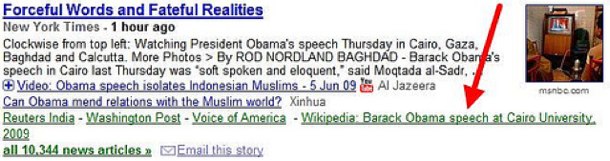
When was the last time you used Google News?

Either those Wikipedian’s are wicked fast or Google News keeps getting slower. I remember when Google News used to bring you (what seemed like at the time) near real-time news results. Now thanks to Twitter, FriendFeed and other real-time social sites I don’t even remember the last time I used Google News.

Seems to me that integrating Twitter into Google News as well as Wikipedia would really provide some value. You’d combine traditional news with crowd sourced reference and real-time context. I’m sure there’s a Grease-Monkey script for that.

Reblog this post [with Zemanta]

Popularity: 1% [?]

Tagged with:
 

The Tweet Stream [v2]

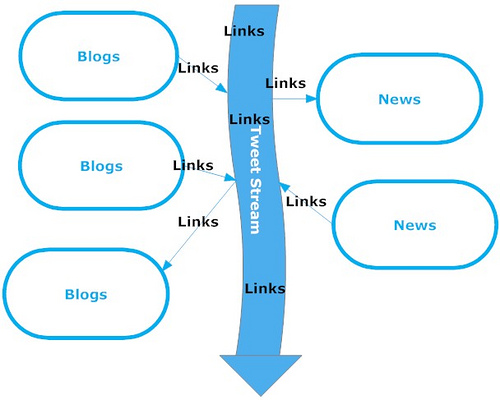
Recent studies and observations have showed that 90% of tweets are made by 10% of the people which is closer to the user behavior of Wikipedia than Facebook (see links at the bottom of the post). One of the primary uses of Twitter by working professionals (the major demographic on Twitter) is for link sharing.

While some felt early on that Twitter would kill blogging I’ve always thought of it as a resource for my blogging. I primarily find and share links via the Tweet Stream. In order to help me explain that to others I created a simple graphic (because I’m not capable of anything else) and I thought I’d share it with you. Feel free to use it yourself. Although if you have any artistic capabilities I suggest you improve on the concept. If you do, please share it back out.

UPDATE: I suck so bad at design that this little project was beyond my grasp. Version one is here, I’ve replaced it with version 2 which ads the arrow at the bottom (signifying the flow of the Twitter stream) and the “Links” so people get that people post blogs and news stories, share the links, which people find via the “Twitter Stream” and that spawns new posts. Yeah, anyway I’m a dork.

Tweet Stream v2

Reblog this post [with Zemanta]

Popularity: 1% [?]

Tagged with:
 

[NCB Best Of] Wikipedia is the best thing ever!

This week marks my 2 year blogiversary. To commemorate one of the things I thought I’d do is re-post some of my better older posts. Oddly enough this is my #1 blog via search engines. Apparently this is still a very popular quote by Michael Scott. I attribute it’s high search ranking to the fact that I posted this just hours after the original show ran. This blog was originally posted on 4/10/07


“Wikipedia is the best thing ever. Anyone in the world, can write anything they want about any subject. So you know you are getting the best possible information.” – Michael Scott


The Office (US TV series)
Image via Wikipedia

I am a huge fan of The Office. The above quote is from April 5th’s (1997) episode. in a very tongue in cheek way, the writers of The Office are highlighting an ongoing social debate. There is constantly (and will continue to be) a debate over the validity and accuracy of information on Wikipedia. To me this is a non issue, for others it is THE issue.
For me what it has done is shown what is possible. People want to share knowledge. People want to colaborate. People will use New Media tools. And most importantly when I talk to clients about wiki’s it gives me an example of a technology that everyone is familiar with.

A wiki is a great piece of technology. How you use it is up to you. If anyone is using a wiki in their workplace please leave a comment here. If you have an example of wiki’s that you use when trying to explain them, other than Wikipedia leave that comment as well. Or if you have your favorite Office quote you can leave that here too.

Reblog this post [with Zemanta]

Popularity: 1% [?]

Tagged with:
 

I will consume and use you

Praying mantis eating cricket

Image by Martin LaBar via Flickr

Some people have a hard time being called a consumer or a user. I don’t have that problem.

I consume/I use

As human being it is essential to our survival (and I would even say our mental well being) to consume. Food, resources, time, money, electricity, etc.

I use your Web site for my own personal enjoyment/gain. I use the information you give me to make myself smarter and I probably won’t give anything back.

I’ll use your freemium service and probably never pay you a dime (even though most of the services I would pay for don’t charge). I read your blog and never click the adds.

I use Google search, mail, calendar, iGoogle, Google Reader, and everything else you throw out there (except Orkut) and never click on an ad.

I’ve never donated to Wikipedia. Have you?

Prosumer

We’ve even invented a new word for those of you who have issues with the reality of your consumption habits: Prosumer.

You think we created a hybrid word from producer and consumer but really all it means is professional consumer.

Prosumers consume phones, laptops and other geek toys like most people consume double venti late’s. (And don’t even get me started on how they consume those.)

Get Real

Many of you like to point out that you produce. You blog, Twitter, upload photo’s, video and life stream. Let’s get real. Do you know what being a 1% really means? It means that if you blog, comment, photo, video, life stream you’re still only producing 1% as much as you consume.

If you take offense to this post please see my previous post.

Reblog this post [with Zemanta]

Popularity: 1% [?]

Tagged with:
 

Web 2.0 and New Media Definitions

There is a lot of confusion around the definitions of Web 2.0 vs New Media. You will hear a lot of people use them interchangeably. Even the above linked to Wikipedia definitions don’t offer much differentiation. So while theses may not be definitive this is the difference as I see them.

Web 2.0 is the technology.

This includes things like: AJAX, Blogs, Wiki’s, podcasts, RSS, widgets and tagging.

New Media is the philosophy.

This is the new approach to how we communicate with each other. This is what makes things like social communities so powerful.

It’s the combination of these two factors at the same time that have created the change that we are experiencing. One without the other is not as powerful.

Web 2.0 is cool, I like the technology but without the philosophy it’s just a cooler way to experience the web.

New Media is great, the approach of many to many and knowledge sharing across multiple groups is extremely powerful but without the technology you are limited to off line geographically limited groups.

Combine the two you you achieve exponential results.

Reblog this post [with Zemanta]

Popularity: 44% [?]

Tagged with:
 

Wikipedia is the best thing ever!

“Wikipedia is the best thing ever. Anyone in the world, can write anything they want about any subject. So you know you are getting the best possible information.” – Michael Scott

I am a huge fan of The Office. The above quote is from April 5th’s episode. in a very tongue in cheek way, the writers of The Office are highlighting an ongoing social debate. There is constantly (and will continue to be) a debate over the validity and accuracy of information on Wikipedia. To me this is a non issue, for others it is THE issue.
For me what it has done is shown what is possible. People want to share knowledge. People want to colaborate. People will use New Media tools. And most importantly when I talk to clients about wiki’s it gives me an example of a technology that everyone is familiar with.

A wiki is a great piece of technology. How you use it is up to you. If anyone is using a wiki in their workplace please leave a comment here. If you have an example of wiki’s that you use when trying to explain them, other than Wikipedia leave that comment as well. Or if you have your favorite Office quote you can leave that here too.

Reblog this post [with Zemanta]

Popularity: 100% [?]

Tagged with:
 

Bad Behavior has blocked 5777 access attempts in the last 7 days.