Will 2010 be the Death of Free and Open?

2012 (film)
Image via Wikipedia

Arrington, I’m really sorry, this seriously sucks.

Mike Arrington can’t get a break. His Last startup, before TechCrunch became his full-time gig, Edgio, DeadPooled 2 years ago and now the CrunchPad joins it’s much older sibling in that same grave almost exactly 2 years later.

This is disconcerting to me for a few reasons:

But what really, really concerns me is what this could be an indicator of.

Open Collaboration

Arrington’s approach with the CrunchPad mirrors very closely the model laid out in the book Collaborative Entrepreneurship. From Amazon:

Collaborative Entrepreneurship: How Communities of Networked Firms Use Continuous Innovation to Create Economic Wealth: Today, the ability of firms to innovate is restricted by barriers both inside the firm and within their existing markets—barriers that produce limited knowledge utilization and incremental innovations. “Collaborative Entrepreneurship” describes how these barriers can be overcome so that shared knowledge can drive continuous, sustained innovation across a network of firms and markets.

The book is very theoretical but prophetic at the same time. I know that the scenarios they lay out in the book won’t come to fruition exactly the way they predict but I do believe they’ll come about in some form.

I loved the blog, hardware crossover Arrington was taking. Hardware is tough. Really, really tough. I always stayed away from business plans that required hardware. Too many hard costs, too many headaches. Arrington’s trials are proof of that.

Cross company collaboration is probably even harder. Even the poster child for open collaboration, Wikipedia seems to be cracking under the pressure:

Free vs IP

What about Cris Anderson and the promise we were given in his book, Free: The Future of a Radical Price? The real irony is that even Chris struggles to reinvent Wired and their business.

I’m also a big fan of Cory Doctorow and his new book Makers which may be more accurate than any non-fiction business book:

  • The decline and fall of America and the boundless optimism of open source/hacker culture
  • Brilliant geeks in a garage, are trash-hackers who find inspiration in the growing pile of technical junk
  • Cheap and easy 3D printing, a cure for obesity and crowd-sourced theme parks

Both Chris and Cory support open/mixed/free (whatever you want to call it) business models. The CrunchPad is the counterpoint to their argument. Greed is the reason we have lawyers and IP laws. It’s a sad reality we have been trying to fight since Gen X started taking corporate jobs.

Content Ownership and Advertising

2010 could be the year that Murdoch pulls his content from Google and hundreds of publishers could follow suit if he’s at all successful. I firmly believe that a publisher should be allowed to do whatever they want with their content but it does move counter to this free and open trend we’ve been living off of.

Hulu’s been great but they are slowly adding more and more ads to their programming, negating half the reason so many of us have flocked to it.

Apple (which made the opposite move Arrington was shooting for, from hardware to content) has recently filed patents for unskippable ads on their devices: Apple Files Patent for Un-skip-able Ads on iPhones, iPods

Even Google, the original purveyors of this free and open movement have been slowly adding more adds to their content to the point that some worry about the lines they may be crossing. Google Experiments With Paid Inclusion & Does “Promoted” Meet FTC Guidelines?

Where’s the Money?

Finally what really worries me is the lack of sustainable revenue from the big social media companies we rely on. Twitter is finally taking the easy fix with advertising and away from their promised premium and value add revenue models.

LinkedIn, Digg, Technorati and Facebook have gotten so huge and taken in so much VC money that the only reasonable exit strategy is an IPO. But none of them have the revenue to support that strategy yet. As this recession plods on and some begin to talk about a possible second dip, despite this “jobless recovery,” You have to wonder what will the big social networks do? How desperate to monetize will they be? Will they be able to deliver on the promise we all bought off on?

Or have the last 5 years been a departure from reality and the fact of the matter is that advertising is the only option and you should never openly collaborate and any collaboration joint venture should only be done with legions of lawyers at your side?

I believe in the open nature of the Internet. I have always believed that open is better than closed. I truly believe that open collaboration is the greatest approach to creating value and economic wealth. But for the first time I have doubts that it’s an unstoppable force.

Reblog this post [with Zemanta]

Popularity: 1% [?]

Tagged with:
 

How I moved up 300 spots in AdAge’s Power 150 in 4 months

First off I would like to say that I do not blog for fame or fortune. I don’t think having a high ranking blog is ever a means to an end. But gaining greater exposure to you content can help meet many a marketing goal. I have said in the past that I blog for three main reason:

  1. I believe that blogging makes you smarter. I would continue to blog if no one ever read this blog. Believe me that there were many times when it really felt like that.
  2. I learned so much from all of you and all of the blogs I read that blogging  is my small attempt to give a little something back. It’s with that intent that I share this post.
  3. By learning what works here on this blog I am able to apply that in my work.

When I started this blog I signed it up for the AdAge Power 150 list not with any hopes of having a high ranking but mostly because I could (so can you if you have a marketing focused blog). The name of the list is a little misleading, there are actually almost 1,000 blogs. If you’re not familiar with the 150 you can get the back story and methodology here. I’d like to point out that there are many great blogs ranked lower than this one that I think are far better. There are also many, many blogs not even listed on the 150 that would crush mine if they were on the list.

Just give me the goods

Don’t want to read this long post but just want my tips? Here they are.

  1. Blog 3 times a day or close to it
  2. Use the right tools
  3. Find a network and engage

Blogging 3 times a day

One of my New Years goals (I don’t really do resolutions) was to blog much more often. I try and blog every day, multiple times a day if I can. But I don’t kill myself trying to do it.

This was the first trick to moving my blog up the ranking. since I first added my blog to the Power 150 this blog was always listed in the 400’s somewhere. (As of this writing I’m at 148. Who knows how long that will last.) Technorati’s State of the Blogosphere found that one thing all of the top blogs had in common was that, on average, they post at least 3 times a day.

What’s funny about that is that 3 times a day has been the Golden Rule of blogging forever. It’s considered the magic number for SEO and it appears to be the magic number for attracting readers.

I don’t have time to do 3 huge posts a day. Honestly I don’t average 3 posts a day and there are many, many successful blogs that only post a few times a week. But if you’re wanting to make your blog better, blogging more often makes you a better writer and keeps people coming back.

Using the right tools

Like I said, I don’t have time for 3 long blog posts a day. Instead I try to throw out several short posts a day and a few longer ones each week. As I’m reading all the various blogs and news each morning, I come across articles that I find particularly interesting and I feel I have some value added thoughts to add. I use the ScribeFire blog editor to grab a link and some quoted text, I add my thoughts (be it what they may) then use Zemanta to add images, links and some related posts then hit post. The whole processs takes about 10 minutes on average.

ScribeFire lets me post quick short posts as I’m reading inspiring material. Zemanta allows me to quickly add all the extra stuff that makes a post a little extra special. Zemanta is also a valuable tool for gaining links, helping me discover other similar blogs and help my blog get discovered on other blogs by adding my posts to the related articles suggestions.

These are the tools that work for me but it’s important to find the ones that work for you.

Find a community and engage

This one ranks second only to having valuable content. One could argue that it is just as important for having a successful blog because if people can’t find your great content then it won’t matter.

I blog a lot about Twitter because I think it’s super cool. I also blog about it because it has by far been the highest value community I’ve been involved in. By being as engaged as I have been with Twitter it has allowed me to meet some wonderful people, share stuff I find cool and allow me to promote my own blog in the process.

Social networks are the #1 source of traffic to my blog. That’s a huge difference from last year. Last year Google was the main source of traffic. This year of all the social networks, Twitter is the main source of traffic.

Weather it’s Twitter, FriendFeed, a network of your favorite blogs, an email distribution list, whatever; get engaged, comment, share.

Beyond even that the main value I get out of being engaged on Twitter is the feedback. The community involvement makes me not just a better blogger but also a better marketer.

Final Thoughts

Much of my progress has corresponded with AdAge’s updates as they’ve tried to make their algorithms better. It’s also important to note that these tips work now but it’s ever evolving. I think these core tipss will always be fundamental but how you apply them will vary from blog to blog and as this space adjusts.

Happy blogging.

Reblog this post [with Zemanta]

Popularity: 1% [?]

When will blogs no longer be blogs?

It amazes me how much this space has evolved over the last 5+ years (yes, blogging has been around longer than that, but I’ve only been actively watching/participating in the space for a little over 5 years).

  • Blogging used to be something that was only used by the geek elite.
  • Then 4 or 5 years ago people started talking about how companies could “theoretically” use blogs to communicate directly to their customers.
  • Today it is something that the largest brands and enterprises use as a key tool in their communication arsenal.

I wonder how much more saturation we’ll achieve? Not every company or every person is going to start a blog and by the time everyone is reading blogs will they even be blogs anymore? By then they’ll just be standard features in Web pages and articles.

Blogging Has Come a Long Way, Baby – eMarketer

“Blogs are now mainstream media,” said Richard Jalichandra, CEO of Technorati. “You’re also seeing mainstream media coming in the other direction by adding blog content.”

This point of view is echoed by David Tokheim, of Six Apart Media. “The lines are becoming blurred between a standalone blog that might be created on TypePad or Blogger or WordPress and blog content that’s created by The New York Times.”

eMarketer estimates that in 2009 96.6 million US Internet users will read a blog at least once per month. By 2013, 128.2 million people, or 58% of all US users, will do the same.

Reblog this post [with Zemanta]

Popularity: 1% [?]

Tagged with:
 

So if you’re like me, you’re NOT at SXSW :( But never fear, here is your complete guide to catching everything at the event without having to be there.
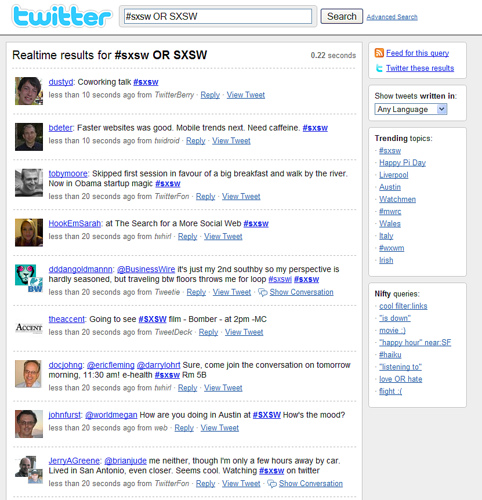
Twitter Search will probably be the most popular real time way to keep up on all the sxsw activities. The biggest problem is that you will see everything. There is no real granular way to sort by certain people or events

sxsw twitter search

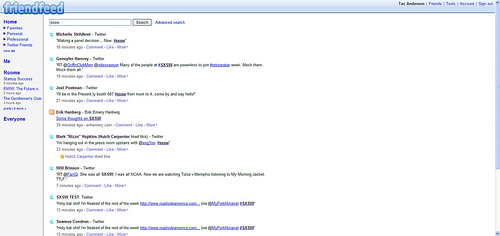
FriendFeed search for SXSW will aggregate the most types of sources. FriendFeed has the most granular level of search. You can either search from just your friends or just by content source or from everything.

sxsw on friendfeed

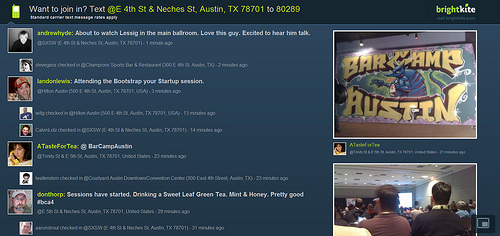
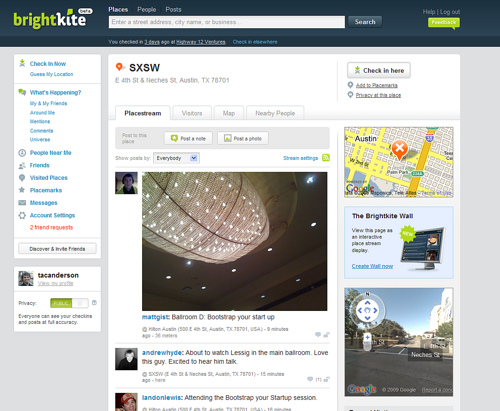
BrightKite Place Stream is another great way to follow SXSW and has more emphasis on pictures. You won’t have as much to sort through which could be a plus or a minus.

sxsw on bkite

The BrightKite Wall is a cool feature that unlike the other mentioned services won’t have you hitting the refresh button over and over again. It also has the ability to pull in other feeds like Twitter search.

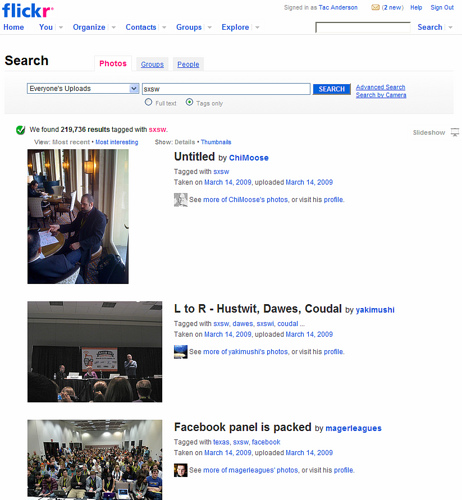
bkite sxsw wall Flickr of course is a great way to actually see the events and people you’re following at SXSW. You can also choose to search by most recent uploads, which I recommend.

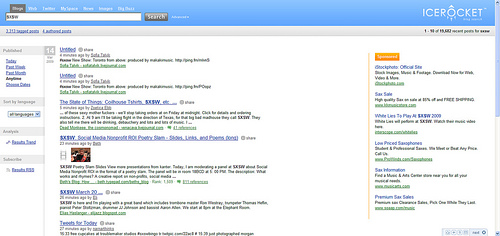
sxsw on Flickr IceRocket is probably the best blog search engine out there and has quietly been building better functionality while Technorati and Google Blog search get most of the attention.  If you want better detail about SXSW than 140 characters then you’ll want to do an IceRocket search and I’d recommend grabbing the RSS feed since some of the best reports won’t come out until after the event. icerocket sxsw search

There it is. Everything I could think of to help you catch as much of SXSW without having to be there. Did I miss anything? Do you have any virtual conference tips?

Reblog this post [with Zemanta]

Popularity: 1% [?]

Tagged with:
 

Brand monitoring tips [Tuesday Homework]

I hope you guys are finding this series of Tuesday posts helpful. Today’s post is for all you corporate types (although this works for agency types working on client accounts).

Monitoring your brand online is critical for two reasons:

  • It helps prevent an online crisis from building up before you are aware of it and can respond
  • It helps you stay connected to how your brand is perceived by the public

The very first thing you should do is set up a Google Alert and/or a Technorati Watchlist for your company. I’ve found Technorati to be quicker but Google to be more comprehensive.

Some of the less common brand monitoring searches include searching on Flickr and YouTube for your brand. This can be a little bit harder because depending on how the person tagged their photos or videos could make it difficult to find relevant content.

Looking through bookmarking sites like del.icio.us, Diigo and Ma.gnolia can also turn up some invaluable results. I’ve often found stuff here the Google Alerts didn’t even turn up.

Following Twitter through services like Tweet Scan can give you a real-time view of what’s happening to your brand. This is where companies can really shine by being on top of customer service issues.

Finally (this one is really for larger companies) something I’ve started doing is searching LinkedIn, Facebook and Twitter for company employees that are using these services. This isn’t so much of a monitoring activity as it is a way to stay connected to what’s happening in my organization.

If I am going to propose an idea that involves buy in or involvement from a separate organization it sure makes it a lot easier if I know an insider that “gets it”. If I’ve already connected to that person they become an invaluable source of information. They can help me talk to the right people and save me weeks of emailing random people or following dead end leads.

Is there anything I missed? Do you have any tips for monitoring your companies brand?

Technorati Tags: ,,,,,,,,,,,,

Reblog this post [with Zemanta]

Popularity: 19% [?]

Tagged with:
 

The rise of crappy pics and vids

Now that I have a 3G camera phone I feel this overwhelming urge to do more with pictures and video. As I’ve stated before I personally still prefer text over video for business applications. But there is no denying that video can really enhance certain types of content.

Pictures are an obvious fit in online content. They provide color, context and good visual elements that enhance a readers experience. That is, if it’s shot by someone with any talent at all. That’s not me.

Here’s a photo I took at the opening of the downtown Boise incubator I helped launch. That’s my wife Jen in the bottom left, she’ll be so happy I used this pic ;)

But my phone and I don’t stop at ruining good photo ops, we also take on video.


This is a group of us waiting for last weeks Boise Twitter lunch. (We would have Twittered from the event, but Twitter was down.)

This is the very first video I successfully shot and loaded up to YouTube with my camera phone. It’s absolutely horrible. I’m actually impressed the audio came out as well as it did. Being a test video and my first one, I can only get better (I hope).

I am not alone in my new visual capabilities. There are hundreds, if not thousands of people a day gaining this new capability via shinny new cell phones. I wonder what will happen as the Web is flooded with this content?

I imagine we’ll see very similar trends that we saw when blogging took online publishing mainstream. Millions of people will upload content daily. The popular stuff will rise to the top, the niche content will find it’s place and the rest will be relegated to being enjoyed by a handful of friends and family members.

If you’re interested my Flickr Stream can be found here and my brand new YouTube channel can be found here.

What do you see happening with the rise of online pictures and videos?

Technorati Tags: , , , , , ,

Reblog this post [with Zemanta]

Popularity: 19% [?]

Tagged with:
 

My Feed Addiction

Image representing delicious as depicted in Cr...
Image via CrunchBase

Steve, over at Micro Persuasion shares some tips on how he manages all of his feeds with Google Reader.  If you’re not using Google Reader, I highly recommend it.  You get cool stats like this:

From your 119 subscriptions, over the last 30 days you read 1,195 items, starred 33 items, and shared 21 items.

That’s only about 40 posts a day, that’s actually a little low.  But that’s only counting the feeds I have in Google Reader.  I also use Google Personalized Homepage, where I manage all the local feeds I track, plus some special interest topics, like music, for a total of 55 feeds.  Then I use the Wizz RSS reader for FireFox, where I follow 10 alert feeds, through Technorati, Del.icio.us and Diigo and the 23 daily “must read” blogs I follow.

Here’s my shared Google Reader feeds.
My Del.icio.us tags feed.
If you want me to find a site just tag it for:tacanderson in del.icio.us and I follow that feed too.

Reblog this post [with Zemanta]

Popularity: 19% [?]

Tagged with:
 

Bad Behavior has blocked 6065 access attempts in the last 7 days.